
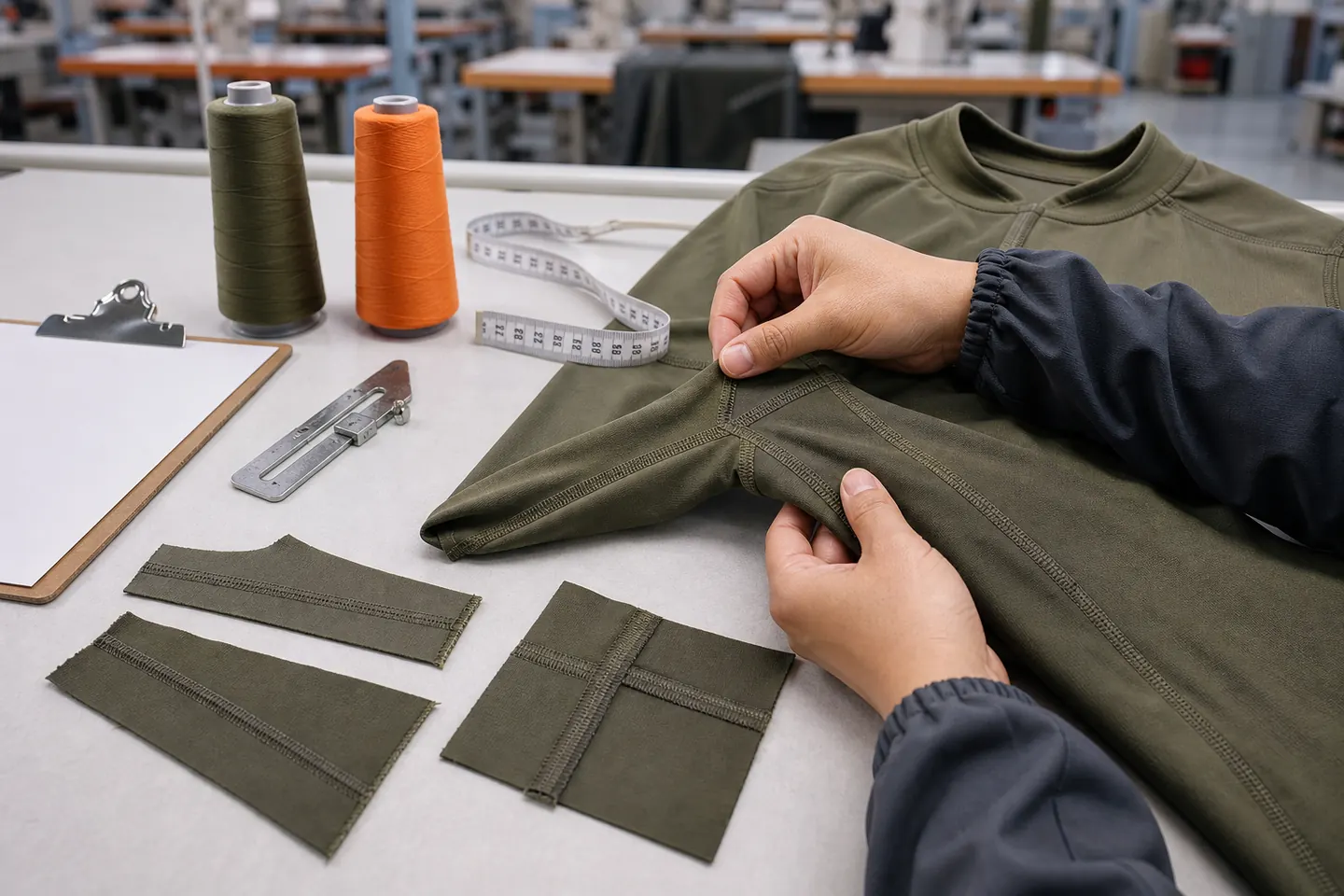
A technical garment brief should not say only ‘strong seams’ or ‘flat seams.’ The buyer and supplier need to agree where each seam sits, what movement and load it experiences, how it is constructed, what the wearer must feel and which approved reference production will follow.
Map seams to movement, stretch and equipment
Choose seam construction by location and use rather than applying one seam type to the entire garment.
Identify next-to-skin zones, high-stretch areas, load-bearing attachments, underarm or crotch junctions and locations that may sit beneath body armour, straps or outer layers.
Record the fabric stretch direction, expected movement and contact pressure at each critical location. A low-profile seam may support comfort in one zone, while another location may require a different allowance, joining method or reinforcement.
Define construction details production can reproduce
The specification should translate the approved sample into clear sewing instructions and visual references.
Agree the seam or stitch class, seam allowance or overlap direction, edge treatment, thread direction, start-and-stop security and reinforcement locations that apply to the actual design.
Do not assume a universal stitch density, needle, thread or tolerance. These details should be selected and approved against the fabric, stretch, appearance and buyer-defined performance route for the project.
Evaluate comfort, bulk and use-cycle risk
A seam can look clean on a table and still create rubbing, restriction or early failure in use.
Review the prototype on the body through the intended movements and layering system. Check seam bulk, edge exposure, stretch recovery, puckering, thread feel and whether junctions or labels create pressure points.
Confirm the applicable wash, care and durability review with the buyer. Inspect seam appearance and security again after the agreed conditioning route rather than relying only on an unconditioned sample.
Create a controlled workmanship reference
The approved garment and seam samples should become production and inspection references.
Keep clear close-up photographs or physical swatches for critical seams, junctions, reinforcements and acceptable visual appearance together with the controlled specification.
Place process checks before repeated defects become difficult to correct, and record any approved change to fabric, thread, construction or equipment for future production and repeat orders.
Buyer brief checklist
- Garment movement, layering and equipment contact points
- Critical seam locations and intended seam or stitch class
- Allowance, overlap, edge treatment and reinforcement direction
- Thread, needle and stitch details approved for the selected fabric
- Comfort, stretch, bulk and pressure-point review
- Buyer-agreed care, conditioning and durability route
- Approved seam samples, photographs and in-process checkpoints
Products connected to this solution
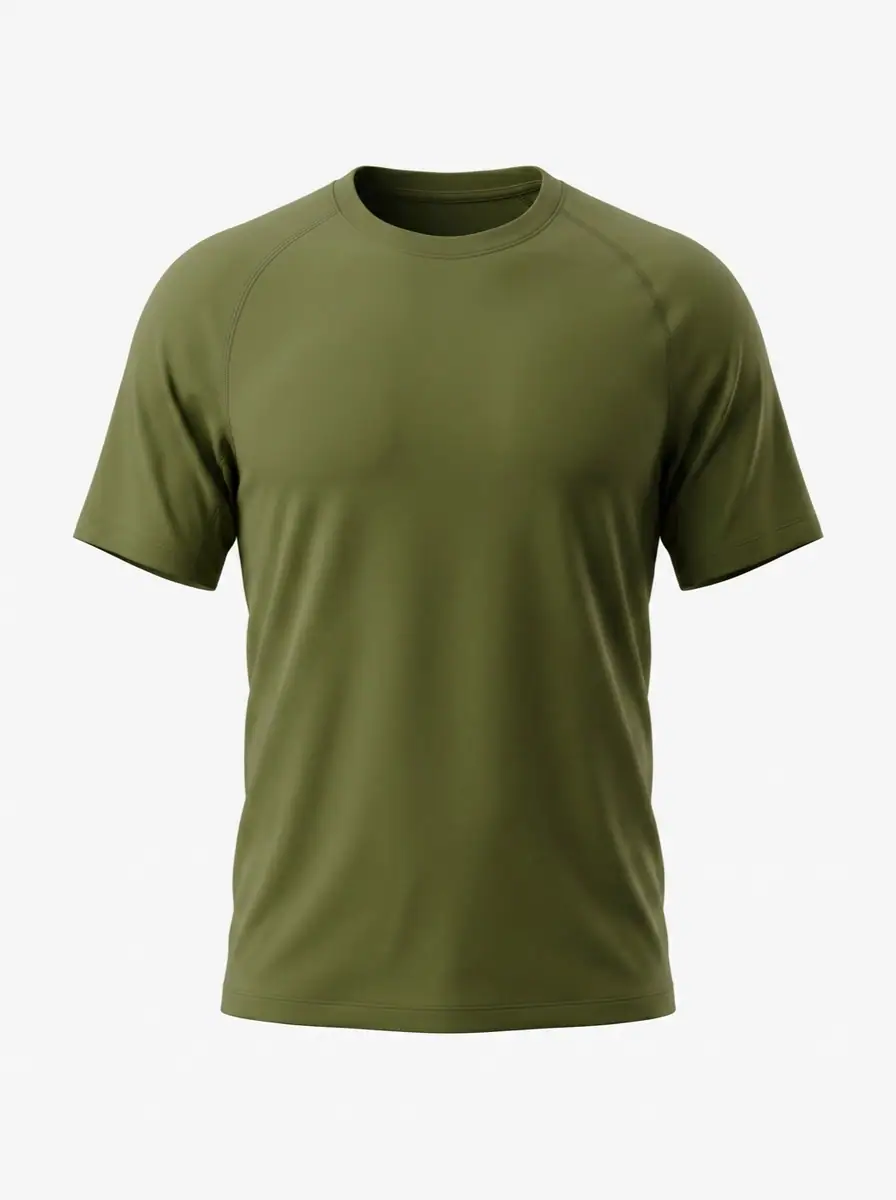 T1-FC001
Military Cooling T-Shirt
Cooling base-layer direction where low-profile seam placement, stretch and next-to-skin comfort should be confirmed during sampling.
View product details ↗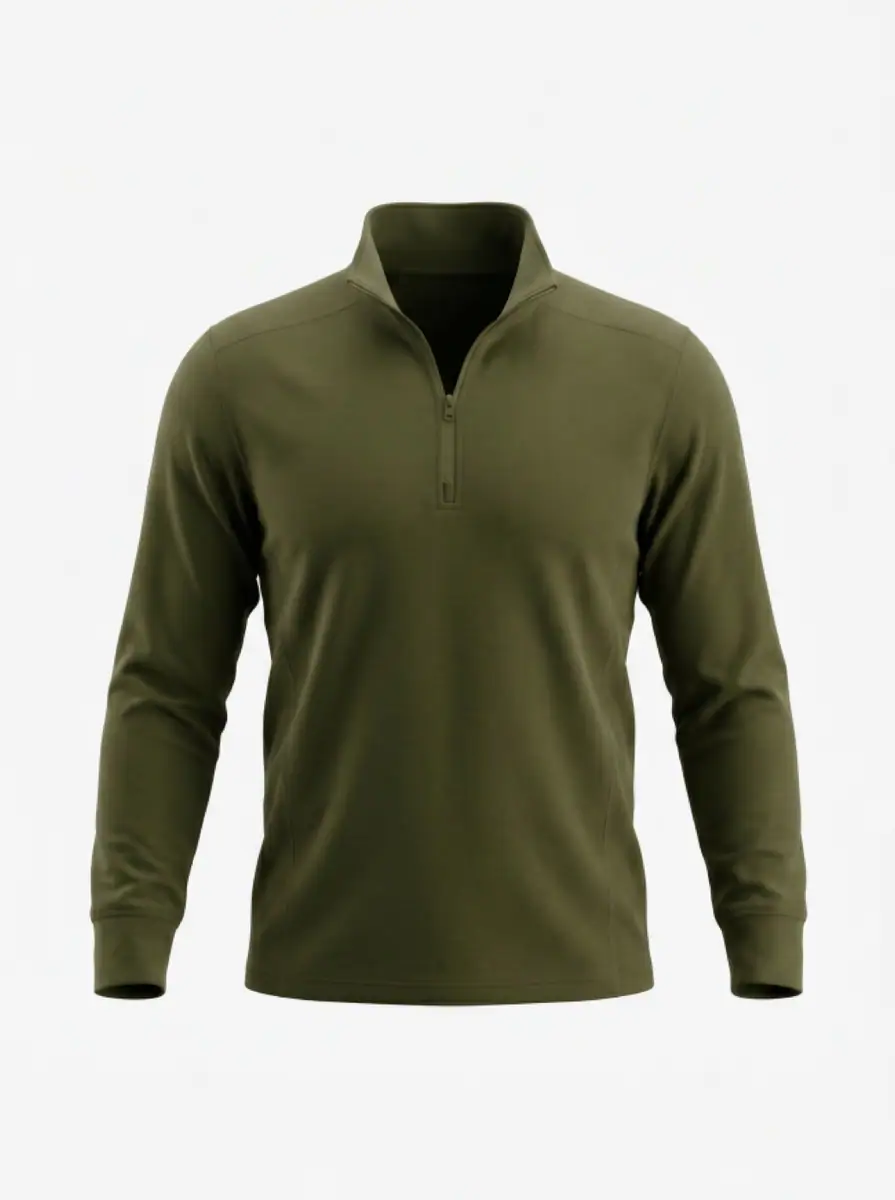 T1-FW001
Military Thermal Underwear Set
Coordinated thermal base layer requiring seam comfort, movement and coverage to be reviewed across the top-and-bottom system.
View product details ↗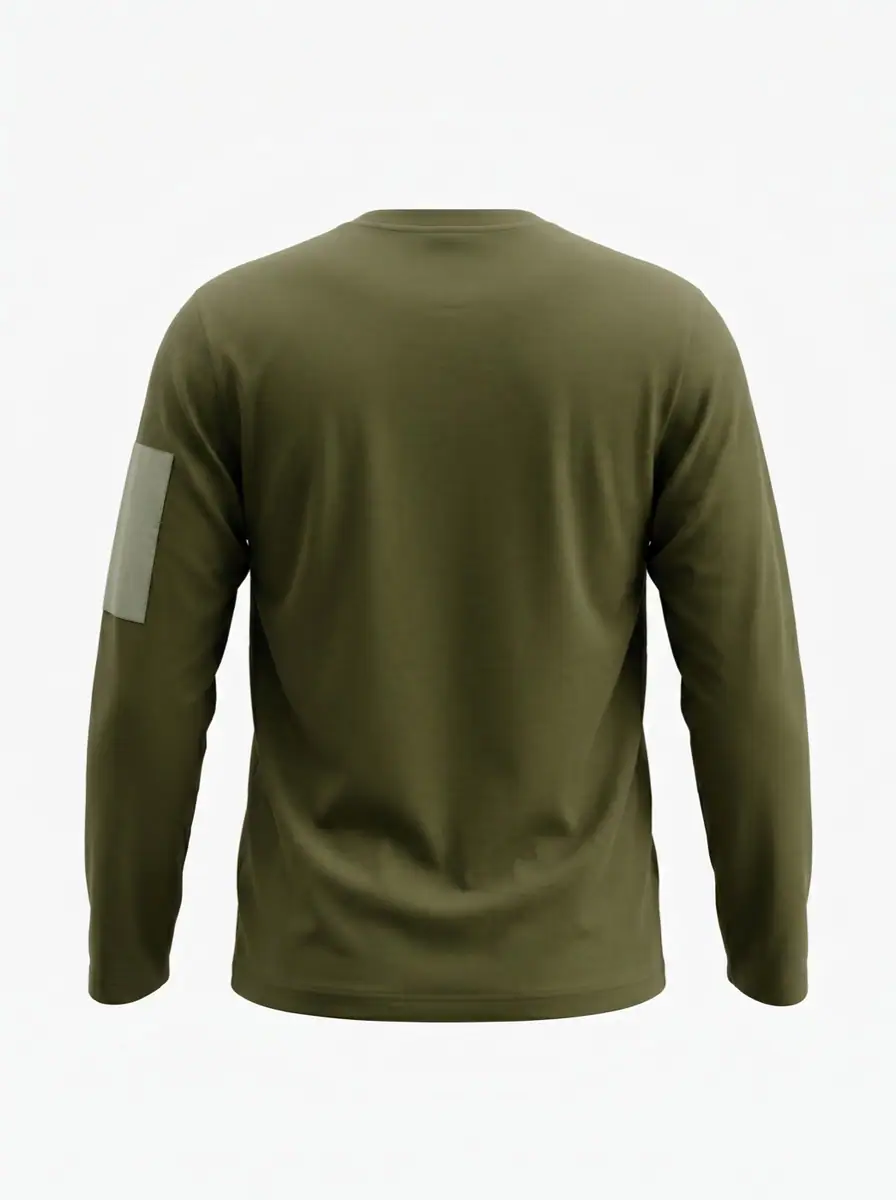 T1-FW003
Military Long-Sleeve T-Shirt
Long-sleeve utility garment suitable for documenting shoulder, sleeve, cuff and body-seam construction against an approved reference.
View product details ↗