
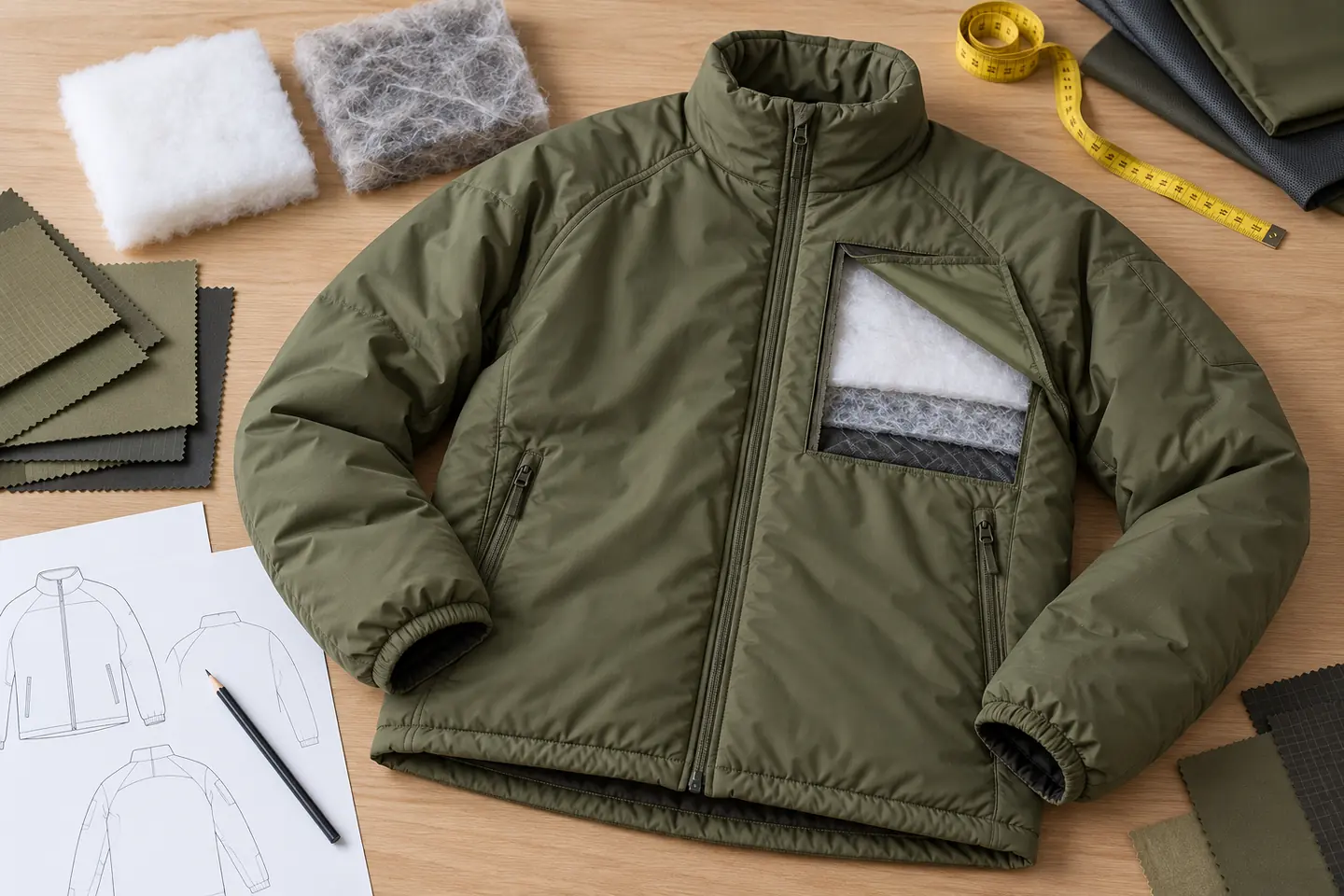
Specify the padded garment as a complete wearing system, not by fill weight alone. Before sampling, agree where insulation is needed, where movement or equipment creates compression, how potential cold spots will be reviewed, and what evidence will approve the finished garment. The image is an AI concept, not a supplied product or factory photograph.
Map the user and insulation zones
Begin with duty cycle, outer equipment and the layers worn underneath; only then define the insulation map.
Separate moving, static and recovery periods, expected moisture exposure, and the points covered by armour, straps or packs. Those conditions influence bulk, ventilation and where insulation can be compressed.
Mark body, sleeve, shoulder, underarm and closure zones on a drawing. Ask the supplier to record the selected shell, lining, insulation type and construction for each zone without assuming one universal fill level.
Review seams, compression and potential cold spots
A warm material sample cannot prove that the assembled garment has continuous coverage.
Inspect panel joins, stitching, quilting, zipper plackets, cuffs, hem and pocket openings against the approved insulation map. Check whether seams, gaps or equipment pressure interrupt coverage during real movement.
Agree a buyer-relevant review method for the finished sample. If thermal imaging or a laboratory method is required, define the setup and acceptance criteria before testing; do not treat a concept image or unrelated report as evidence.
Approve fit, layering and care together
The sample should be assessed over the intended base layer and through the intended maintenance route.
Check reach, kneeling, arm lift, closure use and equipment compatibility across the planned size range. A very bulky construction can restrict movement even when the insulation material itself is suitable.
Confirm wash or cleaning instructions for the actual shell, fill, trims and finishes. Recheck loft, appearance, fit and seam security after the agreed care cycle instead of copying claims from another garment.
Lock the approval and change-control package
Production should follow a controlled sample, fill map and evidence plan rather than an informal warmth claim.
Record material identities, insulation placement, panel pattern, seam and quilting references, measurements, labels, packing and the agreed inspection checkpoints. Keep the approved sample and revision together.
Ask for a documented review whenever the fill, shell, pattern, component or target market changes. Send Leading Protective the use scenario and reference materials so the team can assess the OEM development route; no temperature rating, certification or lead time is implied here.
Buyer brief checklist
- User, climate, duty cycle and equipment
- Intended base and outer layers
- Shell, lining and insulation identity by zone
- Fill map, joins, closures and compression points
- Finished-sample movement and cold-spot review method
- Care route and post-care approval criteria
- Approved sample, inspection records and change owner
Products connected to this solution
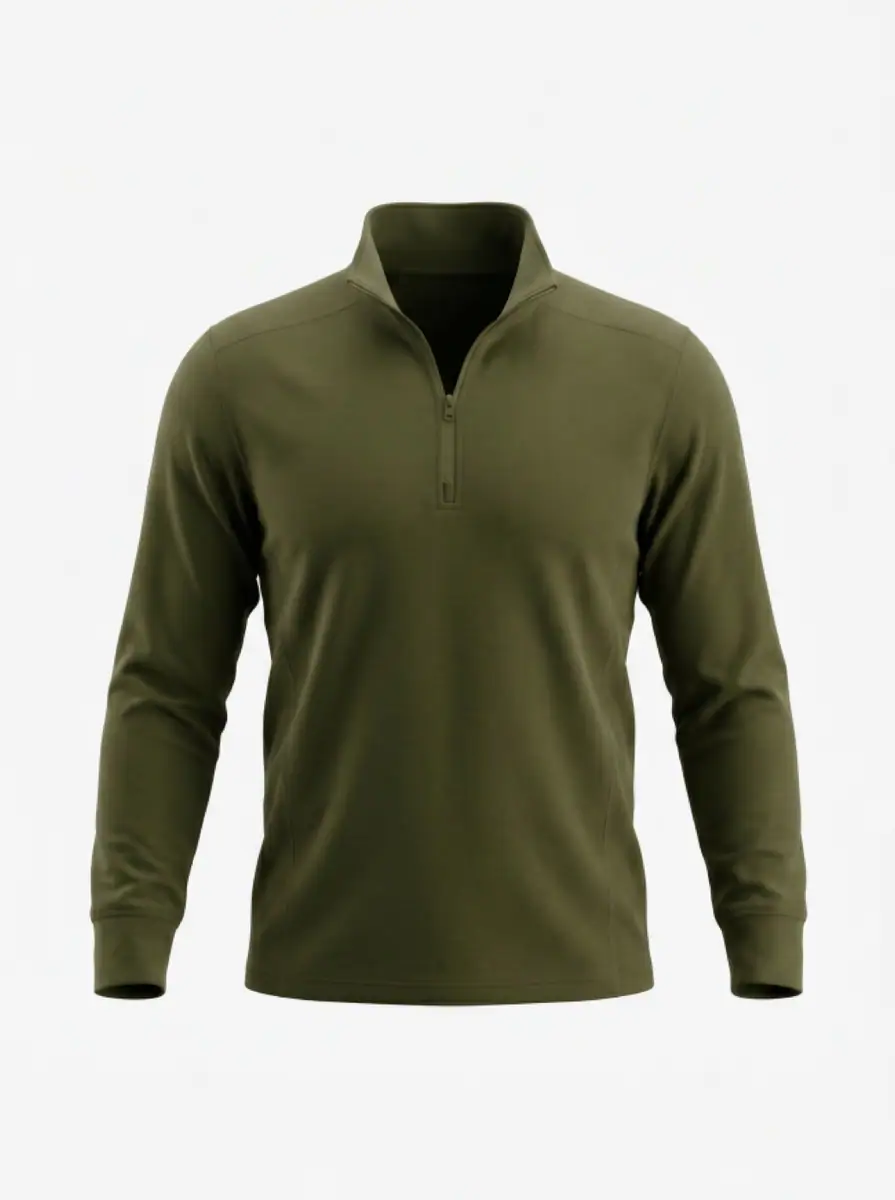 T1-FW001
Military Thermal Underwear Set
Complementary base-layer reference for checking fit and moisture management under an insulated outer garment; not a padded jacket SKU.
View product details ↗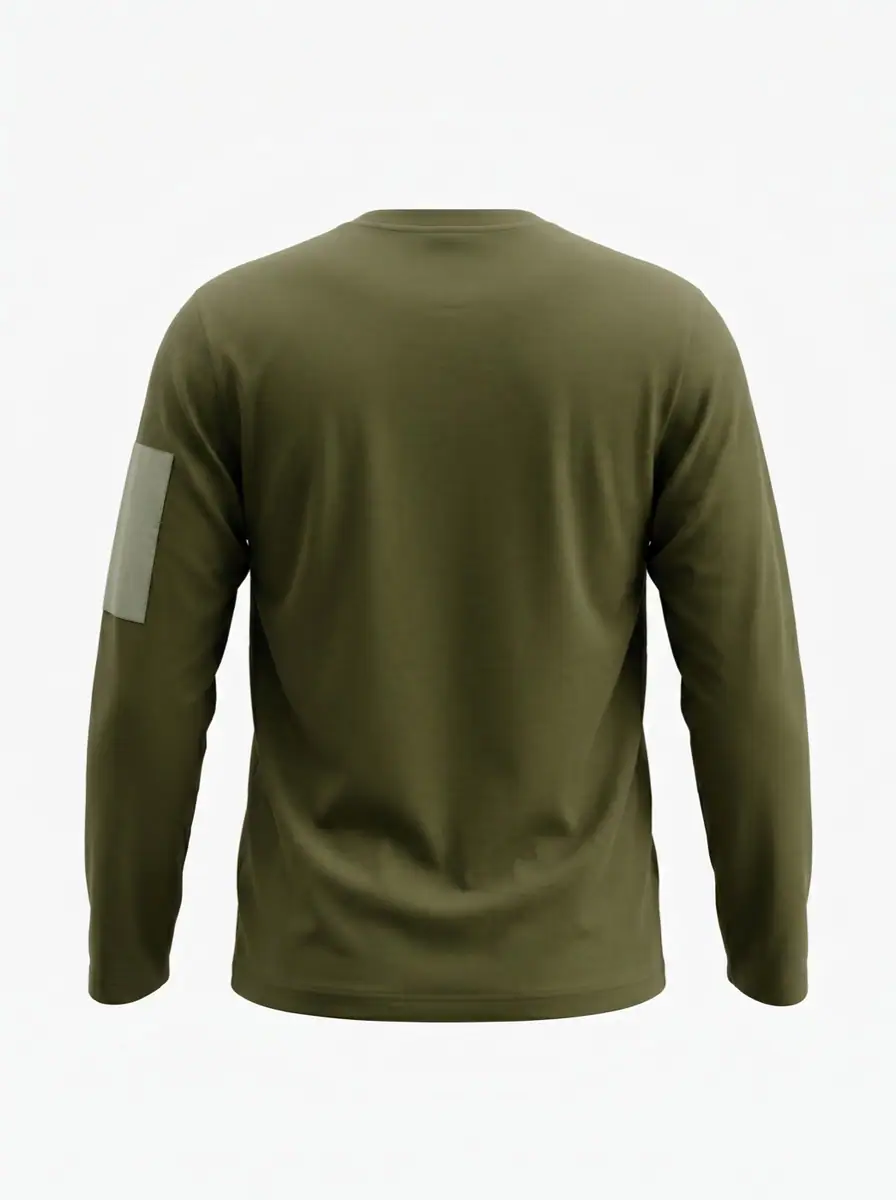 T1-FW003
Military Long-Sleeve T-Shirt
Complementary long-sleeve layer for reviewing movement and layering beneath an insulated uniform; not a padded jacket SKU.
View product details ↗