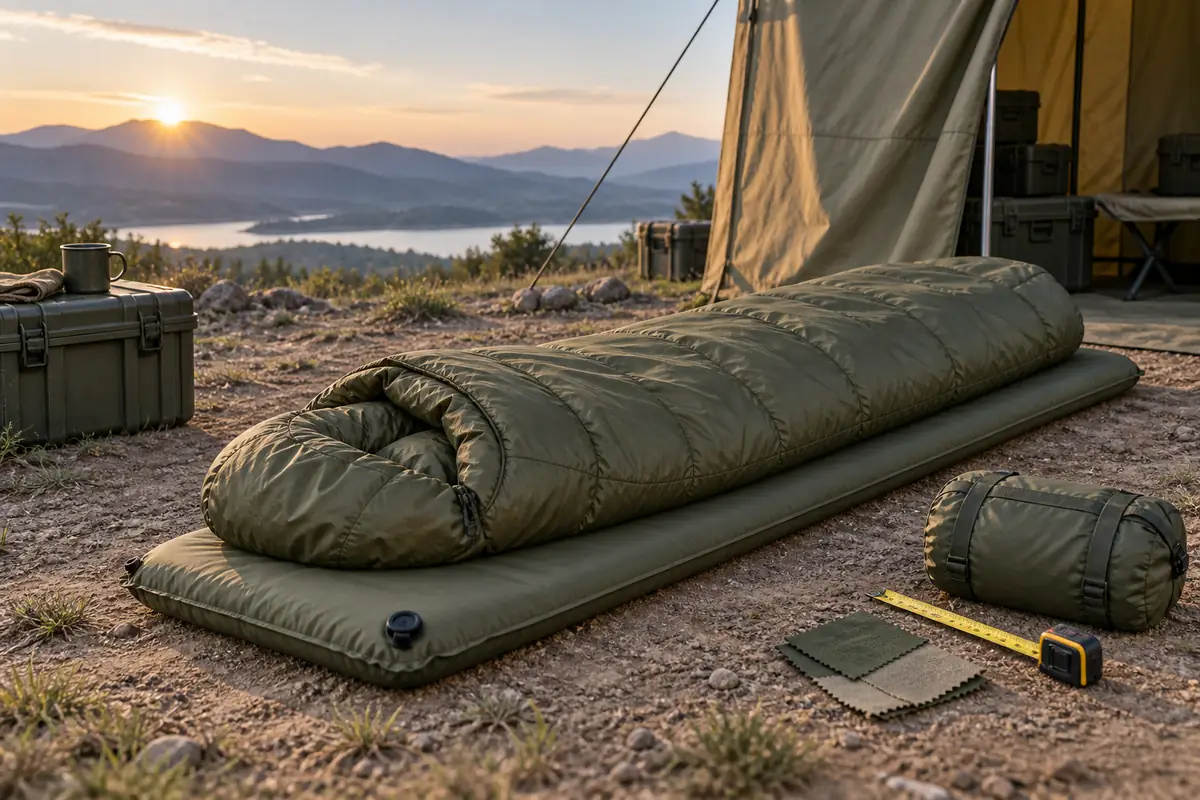
A military sleeping mat should be specified as part of the complete field sleep system, not selected by thickness alone. Buyers need to connect ground temperature, insulation target, user load, packed volume, inflation route, materials and repair expectations to an approved sample and project-specific test plan. The image is an AI-generated concept, not evidence of a supplied product or completed test.
Define the ground and climate before the construction
Start with the lowest expected ground condition, deployment duration and shelter rather than a generic all-season label.
Record ground type, moisture exposure, ambient range, user clothing and whether the mat will be used inside a bivy, tent or vehicle.
If an insulation or R-value target is required, identify the applicable method and buyer acceptance criteria; do not compare unverified values from different methods as equivalent.
Balance insulation, comfort and packed volume
More thickness can improve comfort but also affects weight, pack size, stability and inflation time.
Agree the required dimensions, thickness under load, user weight range, packed dimensions and carrying method.
Review edge stability, movement noise and compatibility with the sleeping bag because the mat and bag work together as one thermal system.
Specify materials, valve and repair route
Shell, coating, seam and valve choices determine how the mat survives transport, inflation and repeated field use.
Define abrasion areas, water exposure, valve position, inflation and deflation method, repair-kit scope and storage instructions.
Agree air-retention, seam, surface and dimensional checks for the actual project. Test conditions and limits must be written into the approved specification.
Approve the complete field sleep system
Evaluate the mat with the intended sleeping bag, clothing layers, shelter and packing system before bulk release.
Confirm fit, thermal-system compatibility, packed configuration, labels, colour, branding and instructions on the approved sample.
Leading Protective can review the fabric-to-finished-product route, with incoming fabric inspection and in-house textile testing aligned to buyer-defined requirements. Final evidence, MOQ and lead time are confirmed by enquiry.
Buyer brief checklist
- Ground, climate, moisture and shelter conditions
- Dimensions, user load and required comfort route
- Insulation target and applicable review method
- Shell, coating, seams, valve and inflation method
- Packed size, weight target and carrying system
- Air retention, durability and repair expectations
- Approved sample, labels, packing and project evidence
Products connected to this solution
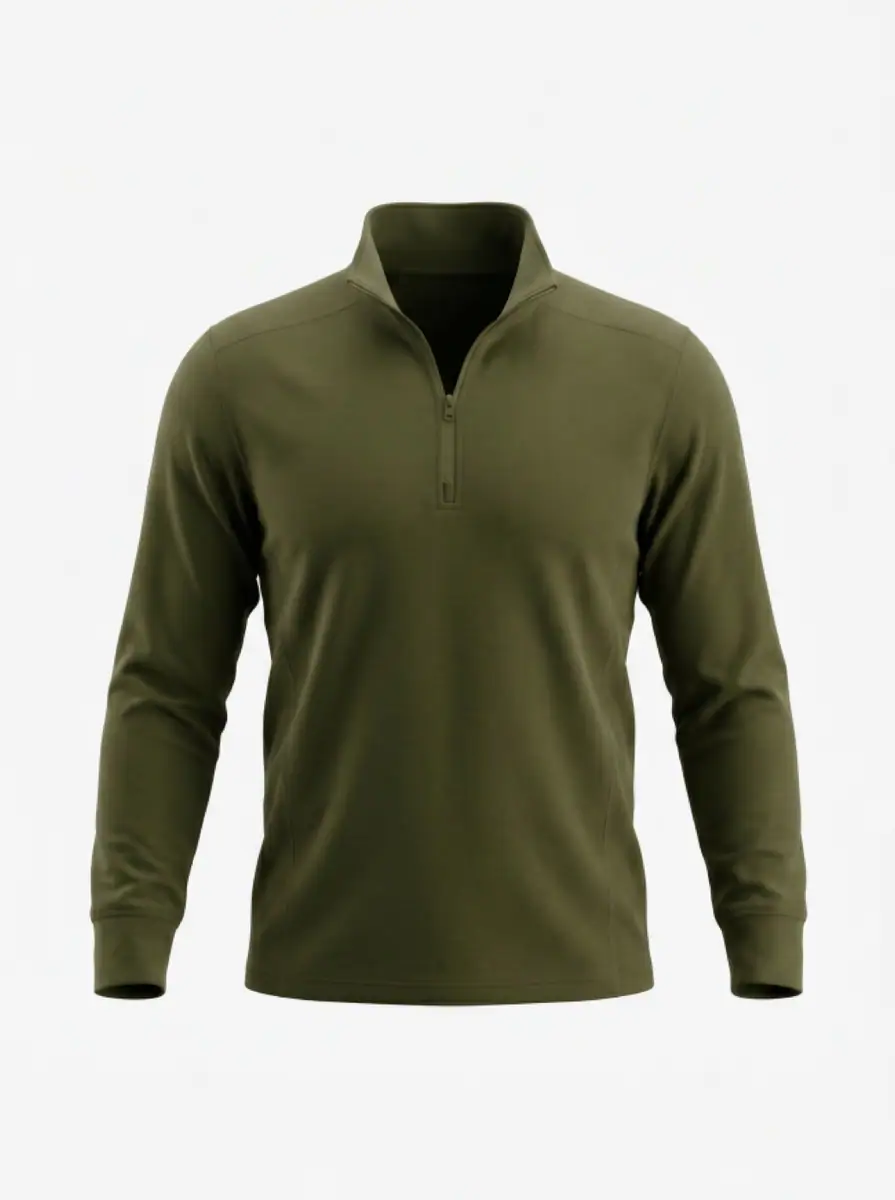 T1-FW001
Military Thermal Underwear Set
A coordinated thermal base layer that should be reviewed with the wider cold-weather clothing and field-rest system.
View product details ↗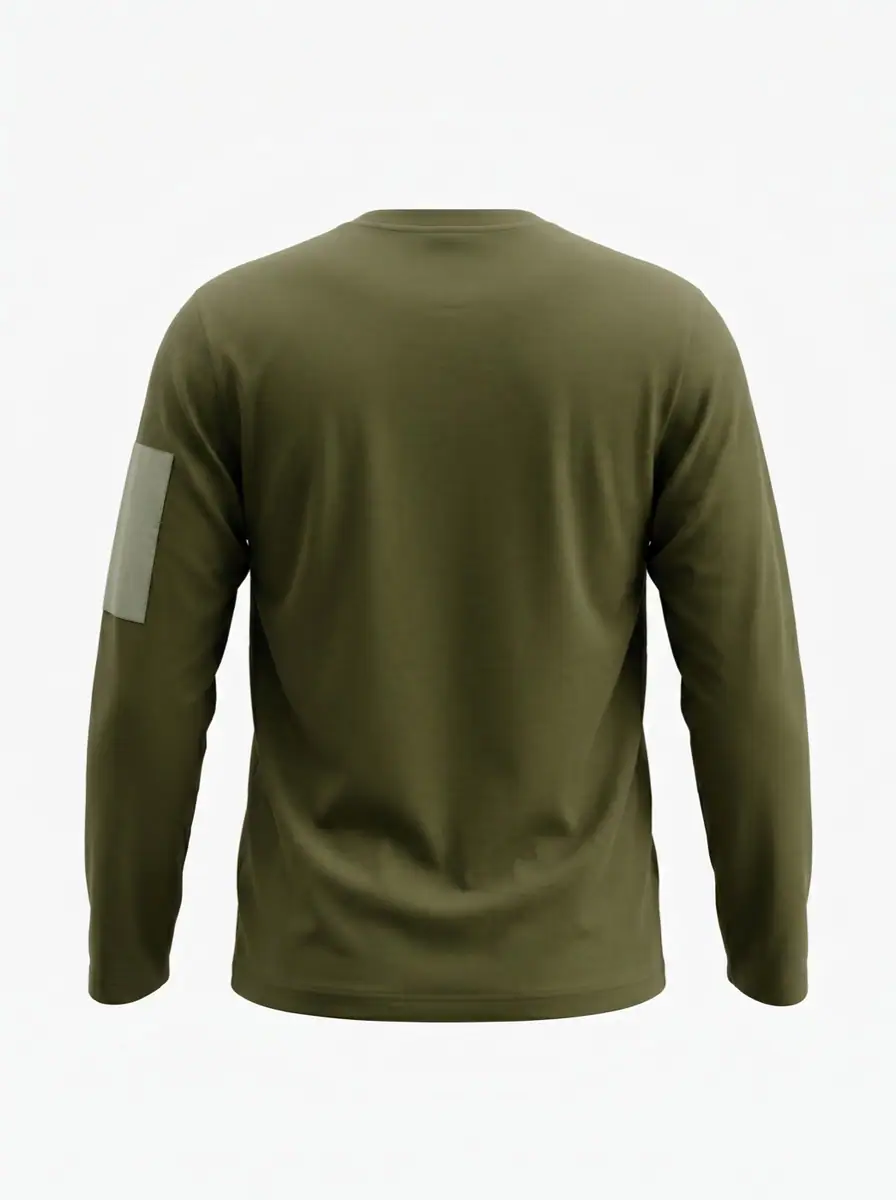 T1-FW003
Military Long-Sleeve T-Shirt
A durable long-sleeve layer for linking duty wear, moisture management and recovery planning.
View product details ↗