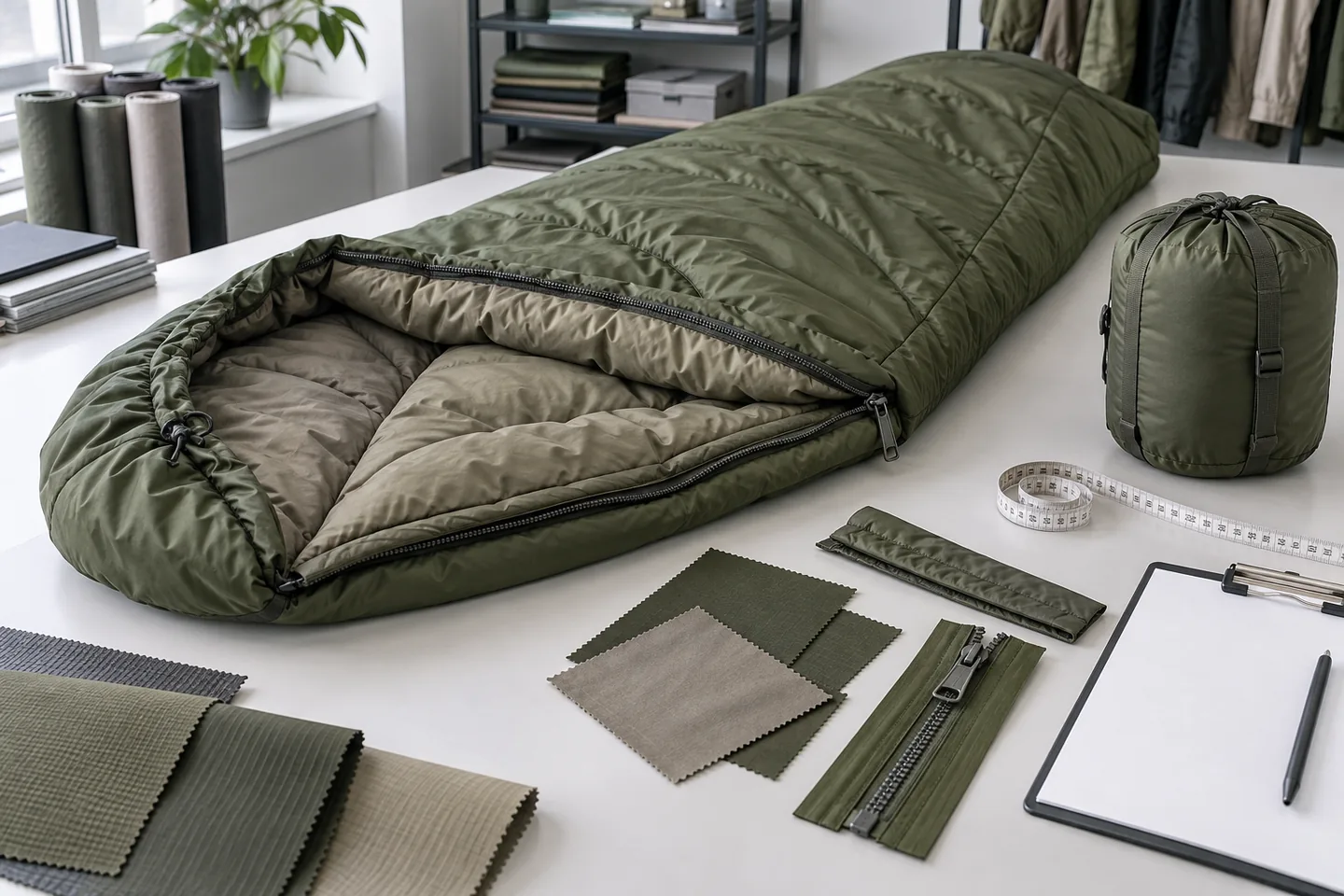
A military sleeping bag brief should define the complete sleep-system requirement before material and construction choices are locked. Buyers need to connect climate, shelter, clothing layers, user dimensions, insulation route, moisture exposure, closure details, packing and validation to an approved sample. The image is an AI-generated concept, not evidence of a supplied product or completed test.
Start with climate, shelter and the complete sleep system
Define where and how the sleeping bag will be used before choosing insulation or a temperature label.
Record the expected night conditions, humidity, wind exposure, shelter, sleeping mat, clothing layers, deployment duration and whether the bag is carried by a person or vehicle.
If a temperature or thermal target is required, identify the applicable test method, sample conditioning and buyer acceptance criteria. Ratings from different methods should not be treated as interchangeable.
Define insulation architecture and garment dimensions
Insulation type, distribution and internal space must work together for the intended user and packing route.
Agree the body shape, shoulder and foot dimensions, length options, hood form, draft-control features and the clothing layers expected inside the bag.
Define the insulation material direction, distribution, stabilization construction and review route without assuming one fill weight or construction suits every climate and user.
Specify shell, lining, closures and construction details
The fabric system and closure details affect moisture handling, durability, snag risk, comfort and field repair.
Clarify shell and lining hand feel, water exposure, breathability direction, colour, zipper side, zipper guard, draft tube, drawcords, reinforcement and any compatible liner or modular connection.
Write the applicable incoming-fabric, seam, zipper, dimensional and workmanship checks into the project specification. Test methods and limits remain buyer- and product-specific.
Approve performance evidence, packing and repeat-order controls
Release bulk production only after the approved sample connects product, evidence and packing requirements.
Review the sleeping bag with the intended mat, clothing and shelter; confirm dimensions, mobility, closure operation, moisture route, stuff sack, packed configuration, labels, instructions and branding.
Leading Protective can coordinate the fabric-to-finished-product route with 100% incoming fabric inspection and in-house textile laboratory support. Final evidence, MOQ and lead time are confirmed for the specific enquiry.
Buyer brief checklist
- Night climate, humidity, wind, shelter and deployment duration
- Sleeping mat, clothing layers and intended user dimensions
- Thermal target, test method and sample-conditioning route
- Insulation material, distribution and stabilization construction
- Shell, lining, zipper, hood, draft control and reinforcements
- Packed size, stuff sack, carrying and storage requirements
- Approved sample, labels, instructions, evidence and repeat-order reference
Products connected to this solution
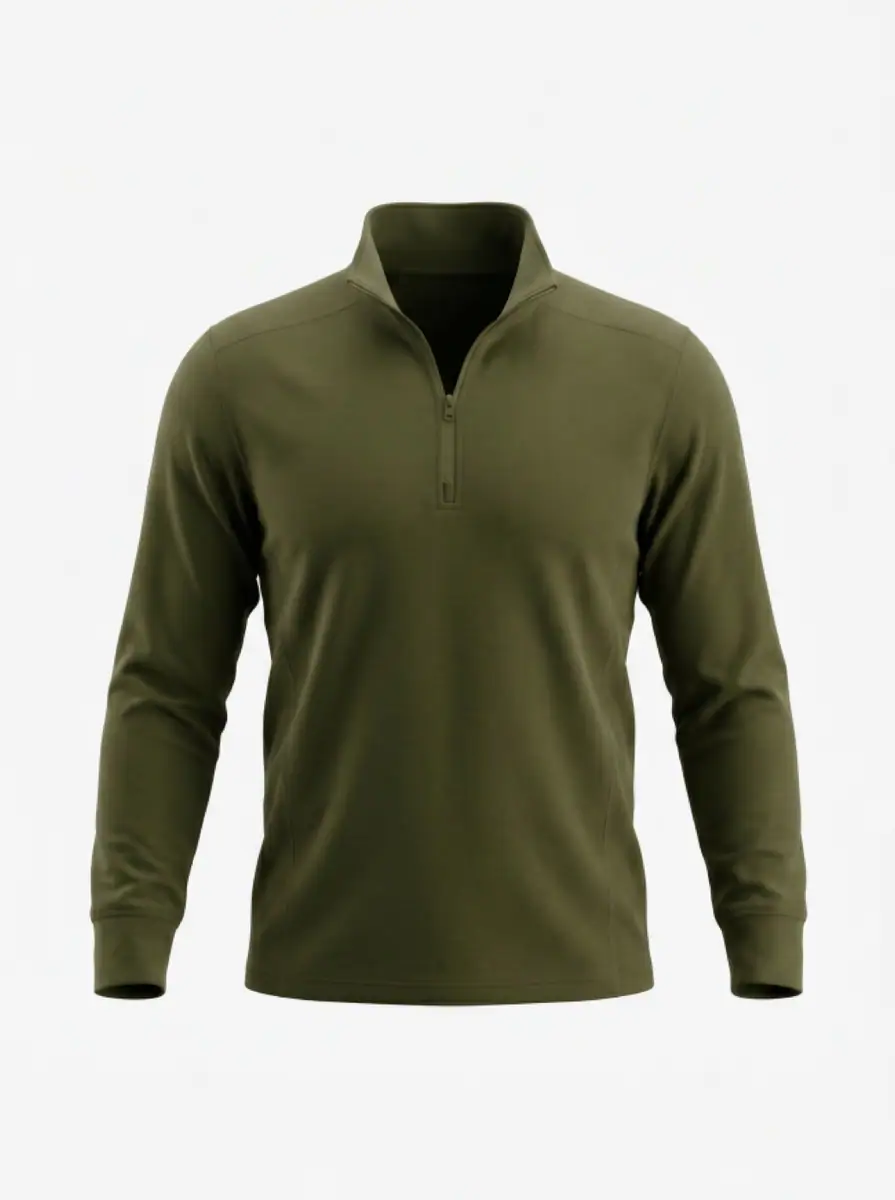 T1-FW001
Military Thermal Underwear Set
A coordinated base layer that should be included when reviewing clothing-inside-bag space and the complete cold-weather sleep system.
View product details ↗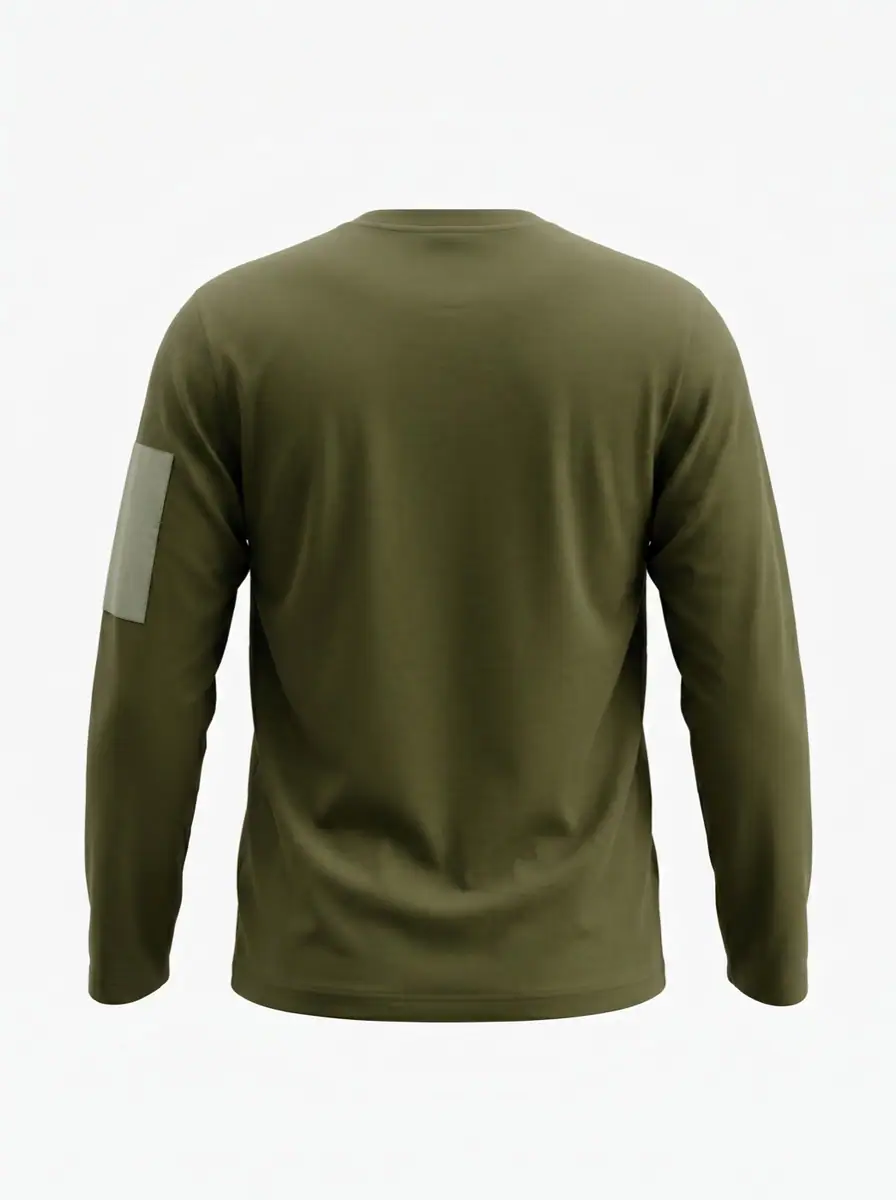 T1-FW003
Military Long-Sleeve T-Shirt
A utility long-sleeve layer for connecting duty clothing, moisture management and field-recovery planning.
View product details ↗